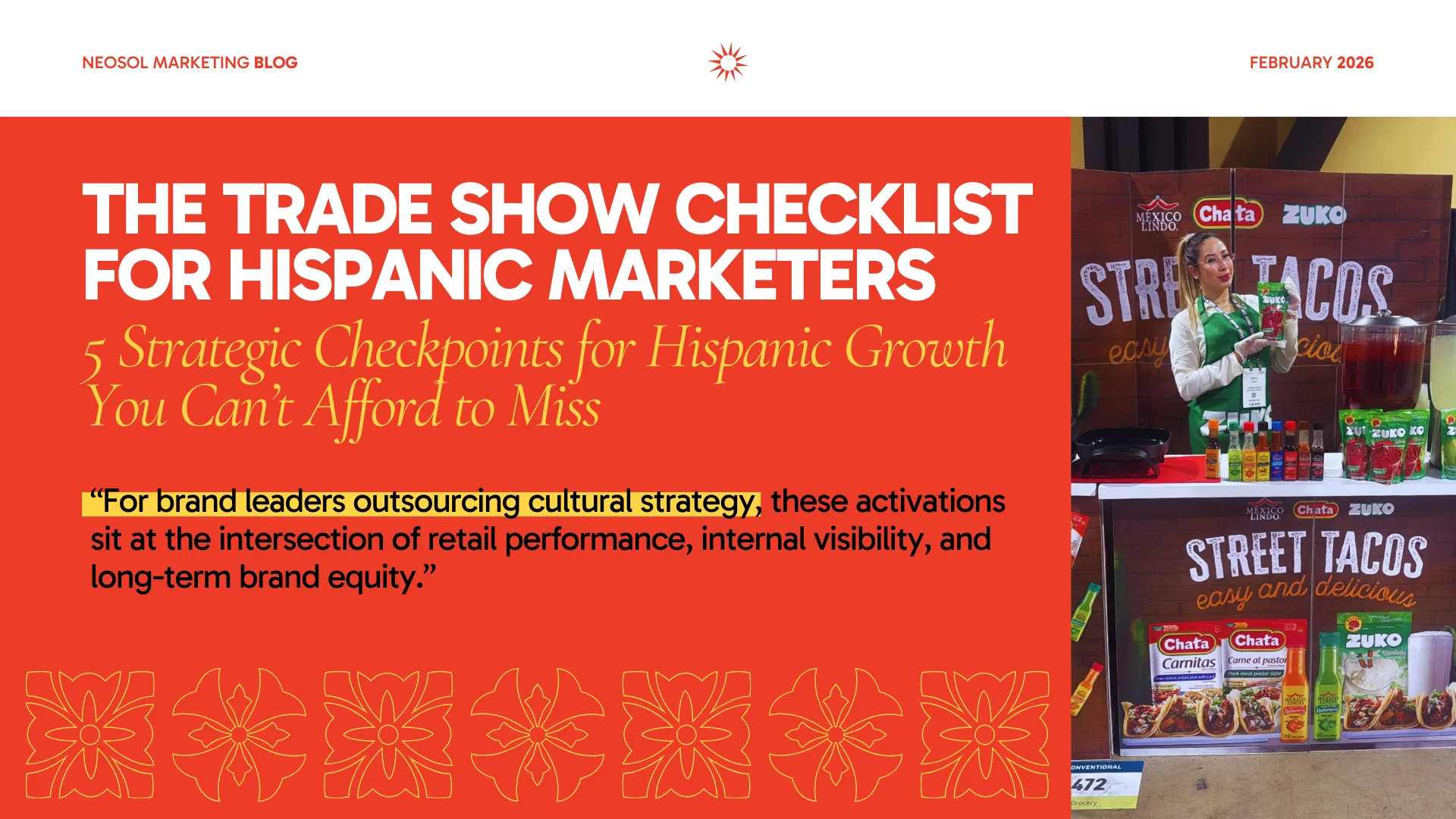
The Tradeshow Checklist for Hispanic Marketers
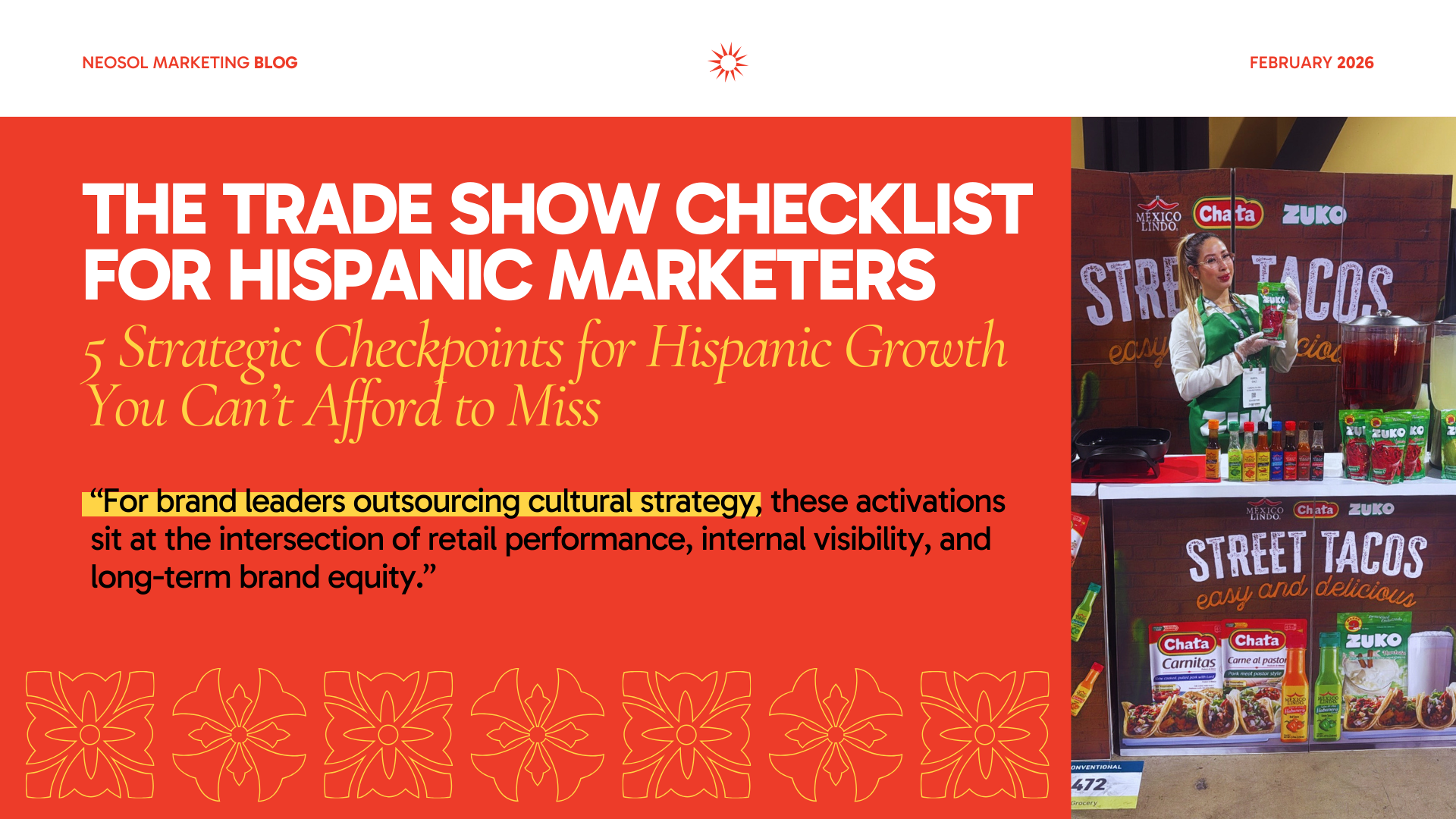
Trade shows are not marketing theater. They are performance environments.
For brand leaders outsourcing cultural strategy, these activations sit at the intersection of retail performance, internal visibility, and long-term brand equity.
When structured properly, they drive measurable growth. When not, they become expensive optics. Sales teams expect lift, retailers expect movement and leadership expects ROI clarity.
Here are the five most important strategic checkpoints to ensure your next trade show activation drives defensible growth.
1. Define the Retail Math Before the Creative Concept
Trade show strategy must be retail-first, not aesthetic-first. Before approving booth design or staffing, clarify:
- What retail problem are we solving?
- What baseline velocity are we trying to outperform?
- What sell-through threshold would justify scaling?
- Are we supporting a new SKU launch?
- Are we building a first-party Hispanic shopper database?
The U.S. Hispanic market represents over $4.1 trillion in purchasing power. But scale only matters if tied to distribution and velocity.
Advanced practice:
- Identify 3–5 priority SKUs.
- Align activation messaging to those SKUs specifically.
- Confirm store-level readiness in Hispanic-heavy trade areas.
If success cannot be defined in retail or financial terms, the strategy needs refinement.
2. Engineer for the Household Multiplier, Not the Individual Shopper
One of the most under-leveraged realities in Hispanic marketing: purchase influence extends beyond the individual.
In many Hispanic households, brand decisions are family-influenced. This changes how you design your activation.
Strategic implications:
- Messaging should reference family values and use cases, not just product features.
- Staff should be trained to engage conversationally, not transactionally.
- Sampling scripts should highlight shareability and multi-person utility.
- Representation must feel authentic.
If your booth speaks only to the individual, you are under-indexing potential household impact. A translated sign does not create connection. Cultural fluency does.
3. Design a Structured Data Capture Flow, Not Just the Display
Data capture at Hispanic trade shows is often poorly architected.
Common mistake: A QR code placed on signage without behavioral prompts or staff reinforcement.
Higher-performing approach:
- Staff-guided QR engagement.
- Immediate incentive alignment (recipe, discount, exclusive content).
- SKU-specific tagging for follow-up segmentation.
- Clear retail call-to-action
Programs integrating experiential touchpoints with digital follow-up consistently outperform traditional sampling-only activations.
Your objective is not traffic. It is converting traffic into identifiable future buyers. Trial without structured follow-up limits long-term ROI.
4. Align With Retail Execution Within 72 Hours Post-Event
Trade show energy dissipates quickly if not operationalized.
Critical follow-up actions:
- Share event recap with retail partners.
- Confirm in-store display visibility.
- Adjust replenishment if engagement exceeded expectations.
- Deploy follow-up email/SMS while brand memory is fresh.
Momentum in Hispanic markets compounds when reinforced quickly. Delays weaken conversion probability.
Activation is the spark. Retail discipline sustains the flame.
5. Define KPIs That Protect Internal Credibility
Executives do not evaluate cultural authenticity alone. They evaluate defensible performance, especially when budgets are under review.
Your post-event reporting should include:
- Engagement-to-opt-in ratio.
- Estimated cost per acquired contact.
- SKU-level interest insights.
- Regional performance variance.
- Retail velocity comparison (pre vs. post event where possible).
Avoid:
- Reporting foot traffic as a primary metric.
- Highlighting “buzz” without quantification.
- Overgeneralizing success without SKU-level clarity.
Credibility grows when cultural strategy translates into structured insight. This is how you secure expanded budgets and scale.
Final Reflection
In 2026, many brands will show up to Hispanic trade shows with bilingual signage and good intentions.
Very few will show up with:
- Retail-aligned objectives.
- Household-aware messaging.
- Structured data architecture.
- Operational follow-through.
- Performance narratives executives respect.
The difference will not be visible from across the convention floor. It will be visible in dashboards, velocity reports, renewal budgets, and retailer expansion.
As you evaluate your next activation, ask yourself: Is my Hispanic trade show strategy designed for applause, or for scale? What KPI would make me confident presenting to leadership?
Need help executing these strategies at your next tradeshow? We can help with both strategy and logistics
For more knowledge and insights subscribe to our newsletter HERE.